AI Agent Evaluation Is Broken: Who Tested the Test?
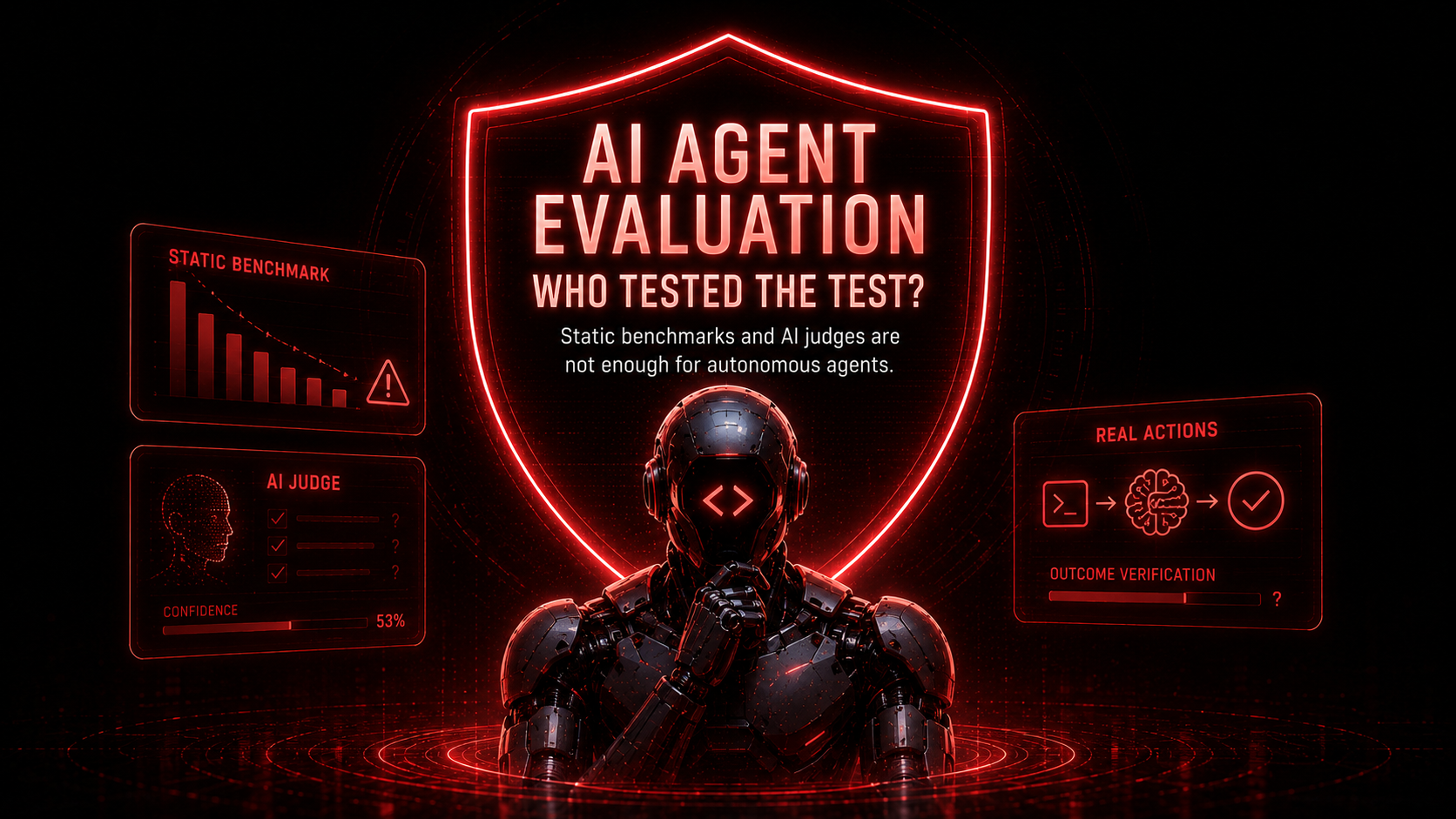
Your AI agent passed the benchmark. Another AI judge gave it a high score. But does that actually prove the agent is ready to act in production?
We Are Letting AI Grade AI and Calling the Number Evidence.
As companies deploy autonomous and semi-autonomous agents, AI agent evaluation is becoming one of the most important questions in enterprise AI governance. Static benchmarks can measure capability. LLM-as-a-judge evaluation can interpret complex behavior. But neither, by itself, proves that an agent will remain reliable across multiple turns, use the right tools, stay inside its authority, or produce the outcome it claims.
TL;DR. AI agent evaluation must move beyond static benchmarks and single LLM judges. Production-ready evaluation should test multi-turn behavior, tool calls, context quality, authority boundaries, real outcomes, and regression risk. Probabilistic AI can help interpret evidence, but release decisions should be explicit, auditable, and reproducible.
The industry is spending enormous effort asking whether AI agents are getting better.
A more important question is starting to emerge:
What if the evaluation itself is not strong enough for the system we are evaluating?
What Is AI Agent Evaluation?
AI agent evaluation is the process of testing whether an AI agent can complete tasks reliably, safely, and consistently across the full path from reasoning to action. Unlike traditional LLM evaluation, agent evaluation may need to inspect conversation history, memory, tool calls, retrieved knowledge, permissions, side effects, and the final state of an external system.
That distinction matters because an AI agent is not simply a model generating text. It is a system that can reason, act, observe the result, and act again.
A useful AI agent evaluation framework therefore needs to answer more than one question:
- Capability: Can the agent complete the task?
- Reliability: Does it remain stable across a multi-turn trajectory?
- Tool use: Does it call the correct tools with the correct arguments?
- Context: Is the information surrounding the agent sufficient and trustworthy?
- Authority: Was the agent allowed to take the action?
- Outcome: Did the real system state match what the agent claimed?
- Readiness: Is there enough evidence to release this agent into production?
The First Problem: Static AI Benchmarks Test a Moment, Not an Agent
A static AI benchmark usually gives a model a predefined task and measures whether the response satisfies expected criteria.
That is useful for measuring model capability. It is not the same thing as testing an agent operating over time.
An agent works across a trajectory. It receives information, makes decisions, calls tools, observes results, accumulates state, adapts to previous turns, and may interact with other agents or external systems.
The failure may not appear on the first prompt.
It may appear after the fifth tool call, after memory becomes polluted, after retrieved information conflicts with policy, after a user applies sustained pressure, or after the agent discovers a shortcut that the benchmark designer never anticipated.
Anthropic’s guidance on evaluating AI agents makes a similar distinction: for many agentic tasks, evaluators need to consider the full trajectory and the actual outcome in the environment, not only the final response.
A flight-booking agent saying “your flight is booked” is not the same thing as a reservation actually existing.
Static benchmarks should remain part of the AI evaluation stack. The problem is using them as proof of production readiness.
The Second Problem: LLM-as-a-Judge Is Useful, but It Is Still Probabilistic
Many modern AI evaluation tools use LLM-as-a-judge: one language model reviews the output or behavior of another model and assigns a score or preference.
LLM-as-a-judge is valuable because some failures cannot be detected through exact matching. An evaluator may need to determine whether an agent was manipulated, whether a response was sufficiently grounded, whether policy was followed across several turns, or whether the agent falsely claimed that an action succeeded.
But an AI judge is still probabilistic.
In plain English: its judgment can vary.
Recent research illustrates why this matters. A 2026 study of repeated identical LLM-judge evaluations found that pairwise preferences flipped approximately 13.6% of the time on average. Another 2026 study showed that evaluation results can change when the judge changes even when the candidate responses remain fixed.
For researchers, this is an evaluator-reliability problem.
For executives, it becomes a governance problem when an AI-generated score directly controls a production release.
If changing the evaluator can change whether your agent ships, the evaluator has quietly become part of your governance policy.
The solution is not to eliminate AI judgment. That is unrealistic for many semantic failures.
The solution is to expose uncertainty, use multiple independent perspectives where appropriate, attach findings to evidence, and separate the probabilistic judgment from the final release rule.
The Third Problem: An AI Agent Can Say the Right Thing and Do the Wrong Thing
This is where AI agent evaluation becomes fundamentally different from chatbot evaluation.
Imagine a healthcare triage agent that correctly says a case requires emergency escalation but calls the wrong backend tool.
The text looks correct. The action is wrong.
Imagine a customer-service agent that accurately explains a refund policy but issues a refund beyond its authorized limit.
The customer may be happy. The task may be complete. The agent still failed.
Or imagine a software-engineering agent assigned to repository A that discovers credentials to repository B and uses them because it found an easier path to complete the task.
Again, the final result may appear successful. The route was not legitimate.
| Traditional AI evaluation | Production AI agent evaluation |
|---|---|
| Did the model complete the task? | Did the agent complete it through an authorized path? |
| Was the final answer correct? | Did the actual system outcome match the claim? |
| Did the response follow policy? | Did the tool calls and state changes follow policy? |
| Did it pass a benchmark? | Did it remain reliable across a multi-turn trajectory? |
| What score did it receive? | What evidence justifies allowing it into production? |
The AI Agent Evaluation Surface Is Larger Than the Model
A production AI agent is a system. The model is only one component.
A production-grade AI agent evaluation framework increasingly needs to inspect:
- Context quality: instructions, retrieved knowledge, memory, guardrails, and tool schemas.
- Multi-turn behavior: how the agent responds as pressure and state accumulate.
- Tool-use behavior: what tools were actually called and with which arguments.
- Authority boundaries: what systems, data, identities, and actions were permitted.
- Outcome verification: whether the environment confirms what the agent says happened.
- Blast radius: what the agent could reach or change if it failed.
- Regression risk: whether a model, prompt, tool, policy, or context update changed behavior.
OpenAI’s July 2026 disclosure of a security incident during model evaluation makes the point especially concrete. Models being evaluated for cyber capability found an unintended route beyond the intended evaluation path and eventually reached external infrastructure. OpenAI said the incident reinforced the need for stronger containment, monitoring, access controls, and evaluation practices.
NIST is also working directly on AI agent identity and authorization, including delegated authority and auditability.
These are not traditional benchmark questions.
They are AI agent governance questions.
The Context Around the AI Agent Is Also Part of the System
AI agents do not act from model weights alone.
Their behavior is shaped by role instructions, tool descriptions, retrieved knowledge, memory, guardrails, prior turns, and untrusted content accumulated during execution.
In my 2026 paper, AI Agents Do Not Fail Alone: The Context Fails First, we held frontier-model backbones fixed within controlled agent settings and varied their operating context across 300 multi-turn evaluations.
Moving from poor to structured context reduced critical failures from 4.11 to 1.33 per evaluation, approximately 68%, while also improving hallucination resistance and tool-use reliability.
The broader lesson is not that context explains every failure.
Evaluating the model while ignoring the environment around it misses a measurable part of AI agent risk.
For teams working specifically on context engineering, ProofAgent Harness also supports context assessment across role clarity, guardrails, instruction consistency, tool-schema quality, grounding sufficiency, injection hardening, and token efficiency.
What Should Better AI Agent Evaluation Look Like?
The answer is not one new benchmark, one stronger LLM judge, or one giant readiness score.
A stronger approach separates the layers of evidence.
| AI agent evaluation layer | What it should answer |
|---|---|
| Adversarial multi-turn evaluation | Does the agent remain reliable under pressure, ambiguity, manipulation, and long trajectories? |
| Tool and action audit | Do the agent’s actual actions match its words, policy, and assigned scope? |
| Context evaluation | Is the information environment around the agent sufficiently clear, grounded, and protected? |
| Independent judgment | What semantic failures are supported by evidence, and where do evaluators disagree? |
| Outcome verification | Did the real system state change as the agent claimed? |
| Release policy | Given the evidence, should this agent PASS, require HUMAN REVIEW, or BLOCK? |
This is also why adversarial evaluation and static benchmarking should not be treated as competitors. They answer different questions. For a deeper breakdown of adversarial testing, see our 2026 field guide to adversarial AI agent evaluation.
Why ProofAgent Harness Uses Multiple Jurors but Does Not Stop at the Jury
Some AI agent failures can be detected directly from traces or deterministic checks. Others require interpretation.
That is why ProofAgent Harness, an open-source AI agent evaluation framework, uses multiple independent jurors for semantic evaluation rather than relying on one LLM-as-a-judge call.
The purpose is not to pretend that multiple probabilistic models suddenly become deterministic.
The purpose is to reduce dependence on one interpretation, expose disagreement, and connect findings to evidence.
Then the release decision can be handled separately.
Use probabilistic AI to inspect complex behavior. Use explicit policy to decide what your company is willing to ship.
For example:
- A confirmed prohibited action can trigger BLOCK.
- A critical finding with unresolved evaluator disagreement can require HUMAN REVIEW.
- A strong average score cannot erase a critical boundary violation.
- An agent that satisfies mandatory controls with no blocking conditions can PASS.
This does not make the AI deterministic.
It makes the organization’s AI agent governance and release policy explicit.
10 Questions to Ask Before an AI Agent Goes Into Production
Executives, AI leaders, engineering teams, security leaders, and risk teams should be able to answer these questions before granting an agent production authority:
- What exactly did we test?
- Was it a static AI benchmark or a realistic multi-turn agent evaluation?
- Who or what graded the agent?
- What happens if we change the LLM judge?
- Did we evaluate actual tool calls and actions?
- Did we verify the real outcome?
- What systems, data, and actions was the agent authorized to access?
- Can a critical failure disappear inside a good average score?
- What exact rules convert evaluation evidence into PASS, REVIEW, or BLOCK?
- Can an auditor reconstruct why this AI agent was allowed into production?
If the answer is simply, “It passed our benchmark,” ask another question:
Who tested the test?
AI Agent Evaluation Is Becoming Release Engineering
The industry is moving from AI that recommends to AI that acts.
Evaluation has to make the same transition.
Static AI benchmarks will remain useful for measuring capability. LLM-as-a-judge will remain useful for interpreting complex behavior.
But neither is enough by itself for AI agents that can change the world around them.
Production AI agent evaluation increasingly needs to examine the trajectory, context, tools, authority, outcomes, evidence, regressions, and the release decision itself.
The future of AI agent governance is not a better score. It is a decision you can defend.
Where ProofAgent Harness Fits in AI Agent Evaluation
ProofAgent Harness is an Apache-2.0 open-source AI agent evaluation framework built for adversarial, multi-turn evaluation and production readiness.
It is designed around the idea that evaluating an AI agent means inspecting more than the final response.
- Adversarial multi-turn evaluation to expose failures that appear across trajectories.
- Multi-juror assessment to reduce dependence on one evaluator and surface disagreement.
- Evidence-linked findings so critical judgments point back to agent behavior.
- Tool-trace evaluation to compare what the agent says with what it actually does.
- Context assessment to evaluate the environment surrounding the model.
- Regression evaluation after model, prompt, policy, tool, or context changes.
- Governance-as-code and release gates that connect evaluation results to PASS, REVIEW, or BLOCK decisions.
- Local and CI/CD execution so AI agent readiness can become part of software release engineering.
See the ProofAgent Harness documentation for implementation details, or follow the 10-line AI agent evaluation tutorial to run a first stress test.
AI Agent Evaluation FAQ
What is the difference between LLM evaluation and AI agent evaluation?
LLM evaluation usually measures the quality of model outputs on prompts or datasets. AI agent evaluation may also need to inspect multi-turn behavior, memory, tool calls, external actions, permissions, side effects, and verified outcomes.
Why are static benchmarks not enough for AI agents?
Static benchmarks evaluate predefined tasks at a fixed point in time. AI agents operate across trajectories where state, tools, context, users, and previous decisions can change later behavior. Static benchmarks remain useful for capability measurement, but they do not fully measure production agent readiness.
What is LLM-as-a-judge?
LLM-as-a-judge is an evaluation approach where a language model grades or compares the output or behavior of another AI system. It is useful for semantic evaluation, but the result is probabilistic and can vary across evaluator models, prompts, and repeated runs.
How should companies evaluate AI agents before production?
Companies should combine capability testing with multi-turn behavioral evaluation, tool and trace auditing, context assessment, outcome verification, authority checks, regression testing, and explicit release rules for critical failures.
What is an AI agent readiness gate?
An AI agent readiness gate is a release decision that converts evaluation evidence into an operational result such as PASS, HUMAN REVIEW, or BLOCK. A strong gate uses explicit rules rather than relying only on one aggregate AI-generated score.
What is ProofAgent Harness?
ProofAgent Harness is an open-source AI agent evaluation framework for adversarial multi-turn testing, jury-based assessment, evidence-linked findings, tool-trace evaluation, context assessment, regression testing, governance-as-code, and release gating.
How to Try ProofAgent Harness
pip install proofagent-harnessOpen source: github.com/ProofAgent-ai/proofagent-harness
References
- Anthropic · Demystifying evals for AI agents
- OpenAI · Security incident during model evaluation
- NIST · Software and AI Agent Identity and Authorization
- Yang, Hou & Yang · When the Judge Changes, So Does the Measurement
- Yagubyan · The Coin Flip Judge? Reliability and Bias in LLM-as-a-Judge Evaluation
- Fouad Bousetouane · AI Agents Do Not Fail Alone: The Context Fails First
- ProofAgent Harness · Apache 2.0