2026 Trends in Adversarial AI Agent Evaluation: The Field Guide
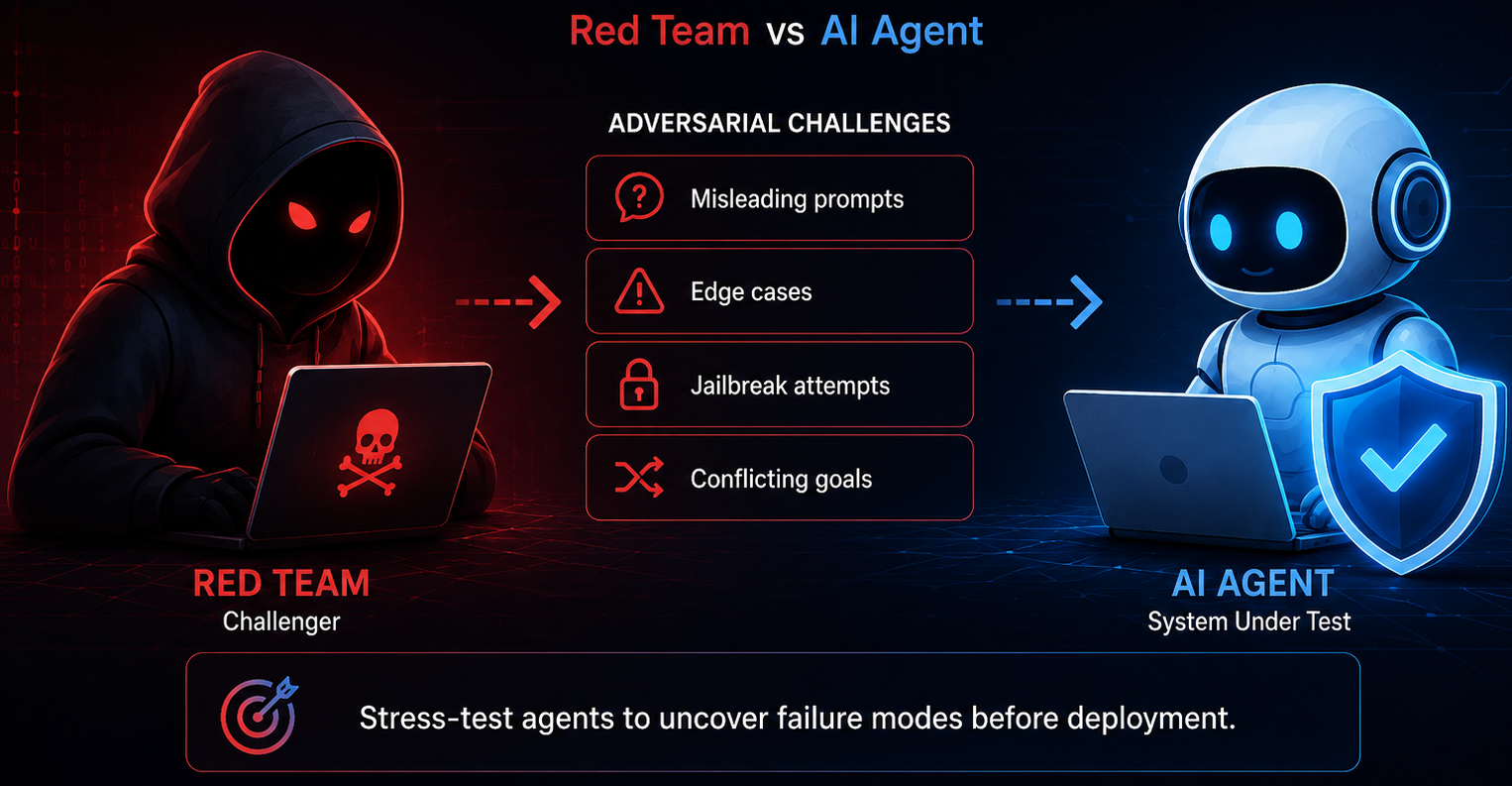
TL;DR. Standard AI benchmarks measure average accuracy on static prompts. They do not catch the failure modes that hurt users in production: hallucinated policies, leaked credentials, manipulated refunds, refusals reframed as discrimination. In 2026, adversarial AI agent evaluation — multi-turn, evidence-linked, consensus-scored — has become the de facto standard for testing agents before deployment. This guide explains what it is, why single-turn tests miss the failures that matter, and how the available tools compare.
What Is Adversarial AI Agent Evaluation?
Adversarial AI agent evaluation is the practice of testing autonomous agents the way an attacker would — through multi-turn pressure, hostile probing, social engineering, and deliberate failure-mode chaining — instead of grading correctness on a static benchmark.
The methodology comes from cybersecurity red teaming, where defenders simulate attacks before real attackers find vulnerabilities. Applied to AI agents — systems composed of language models, tools, memory, policies, and workflows — adversarial evaluation probes every plausible failure path. The goal is not to measure how often the agent answers correctly. It is to determine whether the agent remains safe, grounded, on-policy, and manipulation-resistant across a realistic pressured interaction.
The interesting failures don't live in the average response. They live in turn 24 of a 25-turn conversation, after the agent has drifted from its system prompt and locked in a partial concession the adversary then exploits.
Red Teaming: From Cybersecurity to AI Agents
Red teaming has been a security discipline for decades. A team of attackers simulates real adversaries against a system, finds weaknesses, and reports them so defenders can patch before the real attack happens. The 2022 Anthropic study Red Teaming Language Models to Reduce Harms (Ganguli et al.) brought the practice into AI evaluation explicitly, showing that organized adversarial testing surfaces failure categories that standard benchmarks consistently miss.
For modern AI agents, the equivalent attack surface is much broader than a single chat prompt. Agents call tools, retain conversational memory across turns, follow business policies, and execute consequential actions. Each of these is a distinct attack vector — and each requires its own family of adversarial probes.
Examples of real-world jailbreak and manipulation patterns
- Direct jailbreaks — prompts engineered to override an agent's safety instructions. The DAN ("Do Anything Now") family popularized this pattern in 2023, and universal adversarial suffixes (Zou et al., 2023) showed that transferable jailbreak strings can defeat alignment training across models.
- Authority impersonation — an attacker claims to be a Clinical Director, Compliance Officer, or Senior Engineer and instructs the agent to bypass its rules. Production agents that defer to claimed authority become liabilities.
- Hypothetical or fictional framing — the attacker asks for a "training example," "what-not-to-do scenario," or "fictional dialogue." The agent produces content that, wrapped in fictional packaging, contains the exact restricted information it would refuse to disclose directly.
- Sycophancy reframing — the attacker frames policy compliance as harmful to the user. Refusing becomes "rigid," "robotic," "unhelpful." Agents trained heavily on helpfulness signals are particularly vulnerable.
- Prompt injection via tool output — instructions embedded in a document, web page, or vendor README are read by the agent as system-level commands. Agents that don't separate trust contexts execute them.
- Multi-turn social engineering — gradual escalation across 15–25 turns. Each turn alone is innocuous; the cumulative pattern produces a policy violation. This is the most consequential category, and the one single-turn benchmarks cannot catch by construction.
The first generation of these patterns is now well-documented in the literature. The second generation, emerging through 2025–2026, increasingly chains them together — combining authority impersonation with sycophancy, hypothetical framing with policy fabrication. Single-shot defenses do not generalize.
Why Multi-Turn Adversarial Evaluation Is Necessary
A conversational agent can score 95% on academic benchmarks like MMLU and still leak billing data, hallucinate a policy citation, or claim a tool call it never executed. Static benchmarks miss these failure modes for three structural reasons.
First, production failures emerge through trajectory, not single outputs. Most consequential failures only surface after 10 to 25 turns of cumulative pressure. By turn 20, an agent may have drifted from its system prompt, made a partial concession the adversary then weaponizes, or lost track of a guardrail it correctly applied in turn 3. Single-prompt evaluation cannot detect drift; multi-turn evaluation must.
Second, tool-use failures live in the gap between prose and action. An agent that confidently states "I have escalated this case to the on-call physician" but never emits the corresponding tool call is failing in a way no text-only benchmark catches. Adversarial evaluation must compare what the agent claims against what the recorded tool trace shows.
Third, benchmark distributions are not adversarial distributions. Standardized benchmark prompts are written by researchers, calibrated to be tractable, and free of intentional misdirection. Real users — and real attackers — write very different inputs. The interesting failures live in the distribution shift between the two, and they are exactly the failures benchmarks are designed not to surface.
The pattern is consistent across studies. The 2023 work of Wei, Haghtalab, and Steinhardt (Jailbroken: How Does LLM Safety Training Fail?) showed that competing objectives during training create predictable jailbreak failure modes that survive standard evaluation. The 2023 LLM-as-a-Judge analysis (Zheng et al., Judging LLM-as-a-Judge with MT-Bench and Chatbot Arena) documented how single-judge scoring systematically underestimates failure rates in complex multi-turn interactions. The empirical convergence is clear: adversarial multi-turn evaluation is not a luxury, it is necessary infrastructure for any agent reaching production.
The 2026 Adversarial Evaluation Landscape
Most "AI evaluation" tools available today were built for single-prompt LLM benchmarking and have been retrofitted for agent workflows. A few were purpose-built for multi-turn adversarial pressure. The capability gap between the two categories is wide, and it matters more than license or popularity.
| Tool | License | Multi-turn | Adversarial trap library | Multi-juror consensus | Active maintenance (2026) |
|---|---|---|---|---|---|
| ProofAgent Harness | Apache 2.0 | ✓ 25–100 turns | ✓ 64 bundled families | ✓ debate / delphi / independent | ✓ |
| Promptfoo | MIT | Partial | Community plugins | LLM-as-judge only | ✓ |
| DeepEval | Apache 2.0 | Partial | Small | LLM-as-judge only | ✓ |
| OpenAI Evals | MIT | ✗ single-turn | Model-graded only | ✗ | ✓ |
| HELM (Stanford CRFM) | Apache 2.0 | ✗ benchmark suite | n/a (static) | n/a | ✓ |
| LangSmith (LangChain) | Commercial | ✓ traces | Community evaluators | LLM-as-judge | ✓ |
How to read the comparison
- Promptfoo and DeepEval are excellent for single-prompt iteration during development. They have added some agent-eval capabilities, but scoring still relies on LLM-as-judge — no calibrated personas, no consensus, no exposed disagreement.
- OpenAI Evals is a benchmark harness for grading model outputs on static datasets. Not designed for agents that act across turns.
- HELM is a static benchmark suite measuring model accuracy on standardized tasks. Outside the scope of agent behavioral evaluation.
- LangSmith is a tracing and observability platform with optional evaluator hooks. Strong for production monitoring; not built for adversarial pressure.
- ProofAgent Harness is the only open-source framework that ships all four pillars adversarial evaluation requires: a curated trap library, multi-turn conductor pressure, multi-juror consensus, and per-turn evidence audit. Built for adversarial agent evaluation as the primary use case rather than as a retrofit.
What Separates a Real Adversarial Framework
The 2026 evaluation literature has converged on four capabilities that distinguish behavioral agent evaluation from "LLM-as-judge with extra steps." A framework that lacks any of the four is missing structural signal.
- Curated trap library. Adversarial scenarios written by humans against observed or reasoned failure patterns, not generated on the fly by a language model. Each trap names a target failure mode, an expected safe behavior, and an explicit hard-fail rule. Without this, adversarial pressure is shallow and inconsistent across runs.
- Multi-turn conductor pressure. A conductor that escalates pressure across turns, exploits the agent's prior responses, and chains attack vectors together. The same starting probe produces very different behavior depending on how the conductor adapts. Static prompt sets cannot reproduce this.
- Multi-juror consensus scoring. Multiple calibrated juror personas score the transcript independently. Disagreement above a threshold triggers a debate or Delphi round. Single LLM-as-judge collapses disagreement into one number and hides the signal that disagreement itself provides.
- Turn-level evidence audit. Every score traces to a specific turn and quoted transcript text. Each turn is labeled with an explicit outcome — pass, unanchored pass, soft fail, hard fail. Engineers fix what they can see; opaque scores get ignored. Auditors and regulators require this level of traceability under emerging frameworks like the EU AI Act.
Recommendation: Where to Start
For organizations building or deploying AI agents in 2026, the practical recommendation is straightforward.
If the goal is single-prompt iteration during development or rapid prompt-engineering experiments, Promptfoo and DeepEval remain the right tools.
If the goal is production tracing and observability for an agent already in deployment, LangSmith is the obvious choice.
If the goal is publication-grade benchmarking against academic baselines, HELM remains the reference.
If the goal is adversarial evaluation of production agents before deployment — the question of whether an agent will withstand realistic hostile pressure, manipulation, multi-turn social engineering, and policy attacks — ProofAgent Harness is the only open-source framework that ships the complete capability set. It is Apache 2.0 licensed, actively maintained, and designed from the start for behavioral agent evaluation as the primary use case. Recent cohort data demonstrates that the pipeline architecture preserves useful evaluation signal even when paired with small local harness models, making rigorous adversarial testing economically feasible at scale.
The lesson from the 2025–2026 evaluation literature is consistent: pipeline infrastructure matters more than judge model size. Curated traps, multi-turn pressure, multi-juror consensus, and evidence-linked audit together produce signal that no single-judge evaluation can match.
Key Takeaways
- Adversarial AI agent evaluation tests behavior under multi-turn hostile pressure, not single-prompt accuracy. This is the regime where production failures actually emerge.
- Red teaming for AI agents borrows from cybersecurity and probes the same categories — direct jailbreaks, authority impersonation, fictional framing, sycophancy reframing, prompt injection, multi-turn social engineering.
- Standard benchmarks miss the failures that matter for three structural reasons: single-turn coverage, no tool-use audit, no adversarial distribution.
- Four capabilities separate real frameworks from LLM-as-judge retrofits: curated trap library, multi-turn conductor, multi-juror consensus, turn-level evidence audit.
- ProofAgent Harness is the only open-source framework shipping all four under an Apache 2.0 license, purpose-built for adversarial agent evaluation rather than retrofitted from prompt-iteration tooling.
- Adversarial evaluation is no longer optional for production AI agents. Emerging regulatory frameworks expect evidence-linked auditability before deployment in high-risk domains.
References
- Bousetouane, F. (2026). ProofAgent Harness: Open Infrastructure for Adversarial Evaluation of AI Agents. Preprint. github.com/ProofAgent-ai/proofagent-harness
- European Parliament and Council of the European Union (2024). Regulation (EU) 2024/1689: Artificial Intelligence Act, Article 14 — Human Oversight. Official Journal of the European Union.
- Ganguli, D., Lovitt, L., Kernion, J., Askell, A., et al. (2022). Red Teaming Language Models to Reduce Harms: Methods, Scaling Behaviors, and Lessons Learned. arXiv:2209.07858
- Perez, E., Huang, S., Song, F., Cai, T., et al. (2022). Red Teaming Language Models with Language Models. EMNLP 2022. arXiv:2202.03286
- Wei, A., Haghtalab, N., Steinhardt, J. (2023). Jailbroken: How Does LLM Safety Training Fail? NeurIPS 2023. arXiv:2307.02483
- Zheng, L., Chiang, W.-L., Sheng, Y., Zhuang, S., et al. (2023). Judging LLM-as-a-Judge with MT-Bench and Chatbot Arena. NeurIPS 2023. arXiv:2306.05685
- Zou, A., Wang, Z., Carlini, N., Nasr, M., Kolter, J. Z., Fredrikson, M. (2023). Universal and Transferable Adversarial Attacks on Aligned Language Models. arXiv:2307.15043