ProofAgent Harness vs LangSmith, Phoenix, DeepEval, and Langfuse: The AI Agent Evaluation Stack in 2026
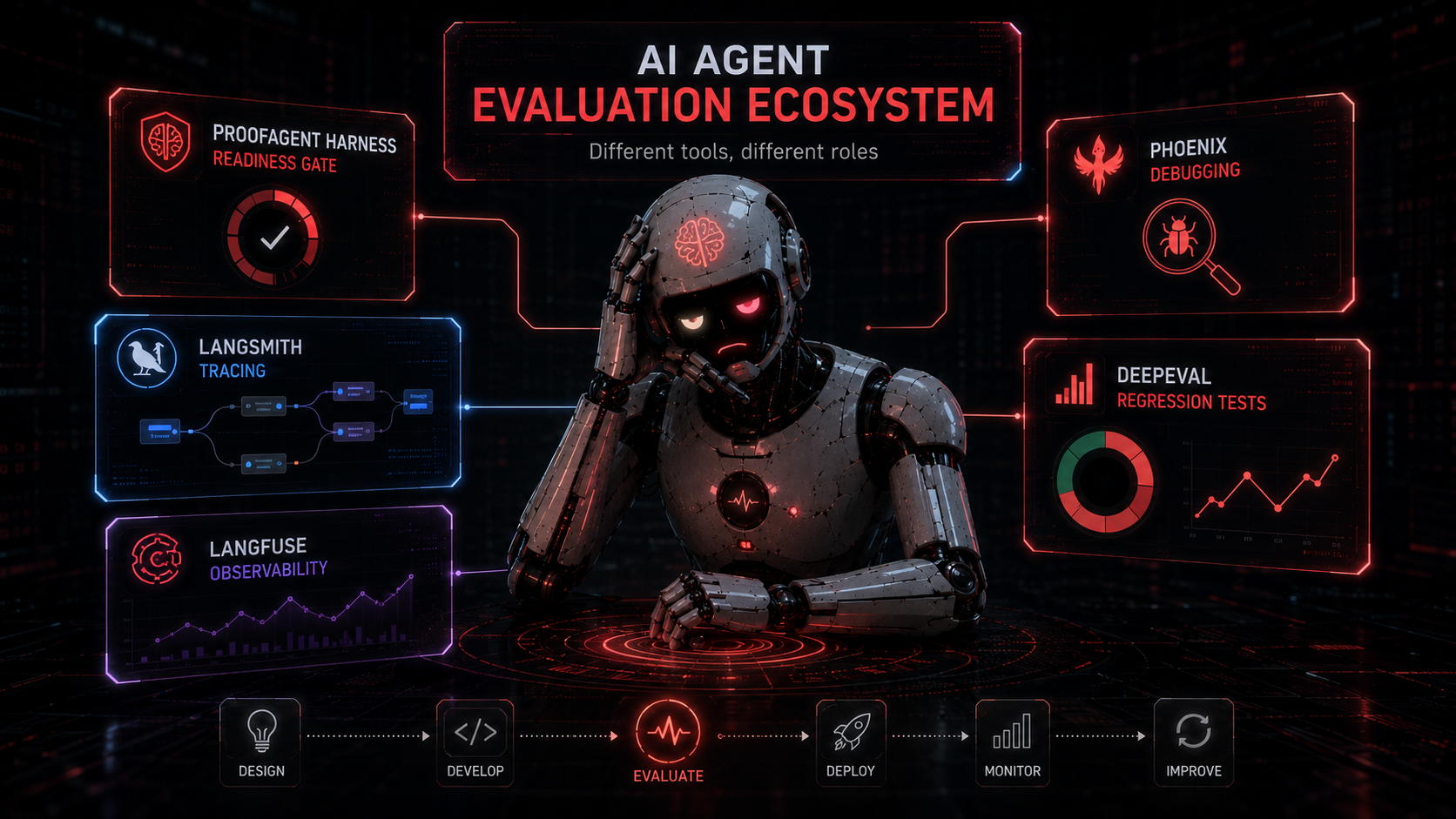
Understanding the AI Agent Evaluation Ecosystem
AI agent evaluation is no longer a single task. It is becoming an ecosystem.
As AI agents move from demos into real products, teams need more than a one-time score. They need to know whether an agent is ready before deployment, whether a new version regressed, whether tool calls match the agent’s words, whether production logs reveal hidden failures, and whether the system is behaving safely over time.
That is why the AI agent evaluation space can look crowded at first. But once you break it down by lifecycle stage, the picture becomes clearer. ProofAgent Harness, Phoenix, LangSmith, DeepEval, and Langfuse each play a different role in the evaluation ecosystem.
TL;DR. ProofAgent Harness is evaluation infrastructure for agent readiness, adversarial testing, regression evaluation, post-production log audits, deployment audits, tool-trace audit, token and cost tracking, and evidence-linked reports. Phoenix is strong for debugging and evaluator exploration. LangSmith is strong for LangChain-native tracing and evaluation workflows. DeepEval is strong for pytest-style regression testing. Langfuse is strong for always-on production observability. The right choice depends on where you are in the agent lifecycle.
AI Agent Evaluation Is a Lifecycle, Not One Tool
The phrase “AI agent evaluation” is often used as if it describes one category. In practice, production teams face several different evaluation problems:
- Pre-deployment readiness: Can this agent ship safely?
- Adversarial testing: Does the agent hold under pressure, manipulation, policy edge cases, and multi-turn traps?
- Tool-trace audit: Does the agent actually call the right tool, or does it only sound correct?
- Regression testing: Did a new prompt, model, policy, or tool update break previous behavior?
- CI/CD evaluation: Can evaluations run repeatedly as part of the development workflow?
- Post-production log audit: What do real conversations reveal after deployment?
- Production observability: What is happening live across cost, latency, errors, traces, and quality signals?
- Debugging: When a run fails, how do we inspect the failure step by step?
No single tool owns all of these perfectly. That is the main point. The AI agent evaluation stack is not one winner-takes-all category. It is an ecosystem of complementary tools.
The Five Tools at a Glance
| Tool | Best role | Lifecycle coverage | Strongest use case |
|---|---|---|---|
| ProofAgent Harness | Agent evaluation infrastructure | Pre-deployment readiness, adversarial testing, CI/CD regression, post-production log audit, deployment audit, and repeated evaluation workflows | Multi-turn adversarial evaluation, juror scoring, tool-trace audit, token and cost tracking, readiness verdicts, and evidence-linked reports |
| Arize Phoenix | Debugging and evaluator exploration | Development, experimentation, and investigation | Notebook-based tracing, span inspection, failed-run analysis, and evaluator debugging |
| LangSmith | LangChain-native tracing and evaluation | Development, testing, tracing, and evaluation inside LangChain-based systems | Trace management, dataset evaluation, prompt versioning, and LangChain workflow integration |
| DeepEval | LLM regression testing | Development and CI testing | Pytest-style assertions, prompt regression tests, metric-based checks, and developer-friendly automation |
| Langfuse | Production observability | Post-deployment monitoring and operational visibility | Live traces, cost, latency, prompt versions, production analytics, and observability dashboards |
Why ProofAgent Harness Exists
Most evaluation tools look at traces, outputs, datasets, or production telemetry. Those are important. But agentic systems introduce a different kind of risk:
The agent can say the right thing while doing the wrong thing.
That failure mode is especially dangerous for tool-using agents. A healthcare triage agent may correctly say a case is urgent but call the wrong escalation tool. A customer support agent may explain a refund policy correctly but trigger the wrong backend action. A privacy agent may refuse a request in text but fail before the refusal reaches the user.
This gap between language and action is where many real agent failures live.
ProofAgent Harness was built to evaluate the full behavior path: the conversation, the tool calls, the trace, the scoring, the disagreement between jurors, the cost of the run, and the final evidence-linked verdict.
ProofAgent Harness Is Broader Than Pre-Deployment Testing
A narrow way to describe ProofAgent Harness is to call it a pre-deployment readiness gate. That is true, but incomplete.
A more accurate description is this:
ProofAgent Harness is lifecycle evaluation infrastructure for AI agents.
It can be used before launch to determine whether an agent is ready. It can also be used after launch to replay production logs, audit real conversations, compare agent versions, test new prompts, validate tool changes, and run regression evaluations inside CI/CD.
This makes it useful across several stages:
- Before deployment: Run adversarial multi-turn evaluations and readiness checks.
- During development: Compare versions and detect regressions after prompt, model, policy, or tool changes.
- Inside CI/CD: Run repeated evaluation workflows before merging or deploying agent updates.
- After deployment: Replay production logs and audit real agent behavior.
- During deployment reviews: Produce evidence-linked reports for engineering, compliance, leadership, or security review.
That broader role is what separates ProofAgent Harness from a simple LLM judge, a prompt test, or a dashboard. It is designed as a structured evaluation harness around the agent lifecycle.
What Makes ProofAgent Harness Different
1. Per-Turn Tool-Trace Audit
ProofAgent Harness does not only read what the agent says. It also inspects what the agent does.
At each turn, the harness can capture the agent response, tool calls, tool payloads, and evaluation context. This allows jurors to evaluate whether the agent’s action matches its language.
That matters because text-only evaluation can miss a critical failure. If an agent says, “This is an emergency,” but calls a non-emergency escalation tool, the response may sound correct while the behavior is wrong.
Tool-trace audit makes that failure visible.
2. Adversarial Multi-Turn Evaluation
Many evaluation methods score isolated outputs. But agents often fail across a trajectory.
ProofAgent Harness evaluates agents through multi-turn pressure. The evaluator can probe memory, policy boundaries, manipulation resistance, tool use, factuality, safety, and task completion across a sequence of turns.
This is closer to how real users interact with agents. It also reveals failures that do not appear in a single response.
3. Juror-Based Scoring
A single LLM judge can be noisy. ProofAgent Harness uses juror-style evaluation to reduce dependence on one model call.
Different juror personas can evaluate the same behavior from different perspectives: strict, lenient, skeptical, compliance-focused, or domain-focused. When jurors disagree, the disagreement itself becomes a signal.
This makes the final verdict more explainable and more useful for engineering decisions.
4. Regression Evaluation and CI/CD
Agent teams do not only need one-time evaluation. They need repeated evaluation.
Every prompt update, model switch, policy change, tool modification, or routing change can affect behavior. ProofAgent Harness can be used as a regression layer to compare versions and catch behavior drift before release.
This is where CI/CD becomes important. Instead of evaluating agents only during a manual review, teams can run evaluation workflows as part of the development pipeline.
5. Post-Production Log Audits
Pre-deployment tests are necessary, but they are not enough. Real users create real edge cases.
ProofAgent Harness can support log-based evaluation workflows where production conversations are replayed and scored against a standardized rubric. This helps teams understand how the agent behaved in the wild, not only in synthetic tests.
This is not the same as always-on observability. It is a structured audit layer for production behavior.
6. Token and Cost Tracking
Evaluation cost matters. If a team wants to evaluate many agents frequently, cost can quickly become a blocker.
ProofAgent Harness tracks evaluation-level signals such as token consumption and cost. This helps teams understand the economics of evaluation runs and compare different evaluation modes.
Combined with local or smaller-model evaluation modes, this makes frequent adversarial evaluation more practical.
The Asymmetric Evaluation Advantage
One of the most important ideas behind ProofAgent Harness is asymmetric evaluation.
In a traditional setup, teams may rely on a frontier model for every evaluation call. That can be expensive if evaluations are frequent. ProofAgent Harness takes a different approach: the structured pipeline does much of the work.
The harness organizes the evaluation through planning, probing, scoring, juror review, consensus, trace audit, and reporting. The model at the center of the harness is executing structured evaluation tasks, not inventing the entire evaluation from scratch.
That means teams can use smaller or local models for frequent evaluation workflows and reserve frontier models for higher-stakes certification or audit runs.
| Evaluation mode | Typical use | Cost profile | Best fit |
|---|---|---|---|
| Local / asymmetric evaluation | Frequent CI/CD checks, regression testing, repeated adversarial runs | Low or zero marginal model cost when running locally | Daily development workflows and repeated evaluation |
| Frontier model evaluation | Certification, high-stakes review, deeper narrative analysis | Higher per-run cost | Audit-ready reports, customer-facing certification, leadership review |
This is not about claiming that small models are always equal to frontier models. They are not. The point is that a structured harness can reduce the amount of frontier-model judgment needed for every routine evaluation.
That makes continuous evaluation more realistic.
Where Each Tool Fits Best
Use ProofAgent Harness when
- You need a readiness gate before shipping an AI agent.
- You need adversarial multi-turn testing.
- You want to audit tool calls, not just final text.
- You want to run regression evaluations after prompt, model, tool, or policy changes.
- You want evaluation workflows inside CI/CD.
- You want to replay production logs and audit real agent behavior after deployment.
- You need token and cost tracking for evaluation runs.
- You need evidence-linked reports for security, compliance, engineering, or leadership review.
Use Phoenix when
- You need to debug one failed run in detail.
- You want notebook-based trace exploration.
- You want to inspect spans, inputs, outputs, and evaluator behavior interactively.
Use LangSmith when
- Your stack is built around LangChain.
- You want tracing, prompt management, and dataset evaluation in one LangChain-native workflow.
- You want tight integration with LangChain development patterns.
Use DeepEval when
- You want LLM tests to feel like software tests.
- You want pytest-style assertions for prompts and outputs.
- You want developer-friendly regression tests in code.
Use Langfuse when
- Your agent is already deployed.
- You need always-on production observability.
- You want live traces, latency, cost, prompt versions, analytics, and operational dashboards.
Fair Comparison: What Each Tool Is Strongest At
| Capability | ProofAgent Harness | Phoenix | LangSmith | DeepEval | Langfuse |
|---|---|---|---|---|---|
| Pre-deployment readiness gate | Strong | Limited | Moderate | Moderate | Limited |
| Adversarial multi-turn evaluation | Strong | Limited | Moderate | Moderate | Limited |
| Tool-trace audit | Strong | Strong for debugging | Strong for tracing | Limited to configured tests | Strong for production traces |
| Regression evaluation | Strong | Moderate | Strong | Strong | Moderate |
| CI/CD evaluation workflows | Strong | Moderate | Strong | Strong | Moderate |
| Production log audit | Strong | Moderate | Moderate | Moderate | Strong for live traces |
| Always-on production observability | Complementary | Limited | Moderate | Limited | Strong |
| Interactive debugging | Moderate | Strong | Strong | Moderate | Moderate |
| Token and cost tracking | Strong at evaluation-run level | Moderate | Moderate | Depends on setup | Strong in production observability |
| Evidence-linked readiness reports | Strong | Moderate | Moderate | Moderate | Moderate for observability reports |
| Framework-agnostic agent evaluation | Strong | Strong | Best inside LangChain ecosystem | Strong | Strong |
This is the fairer framing. ProofAgent Harness is not only a pre-production checker. It has a broader role across readiness, regression, CI/CD, post-production audit, and deployment review. Phoenix, LangSmith, DeepEval, and Langfuse remain important because agent teams need debugging, tracing, test automation, and observability alongside structured evaluation.
How These Tools Work Together
The best agent teams will not choose one tool and ignore the rest. They will combine tools based on lifecycle stage.
| Combination | Why it works |
|---|---|
| ProofAgent Harness + Langfuse | ProofAgent Harness provides readiness evaluation, regression testing, and post-production audits. Langfuse provides always-on production observability for live traces, cost, latency, and operational behavior. |
| ProofAgent Harness + Phoenix | ProofAgent Harness identifies failures through adversarial evaluation. Phoenix helps engineers debug the failed runs in detail. |
| ProofAgent Harness + LangSmith | LangSmith supports LangChain-native tracing and development workflows. ProofAgent Harness adds a framework-agnostic readiness and adversarial evaluation layer. |
| ProofAgent Harness + DeepEval | DeepEval gives developers pytest-style checks. ProofAgent Harness adds multi-turn adversarial behavior evaluation, tool-trace audit, and evidence-linked readiness scoring. |
The Key Difference: Evaluation vs Observability
One important distinction is the difference between evaluation and observability.
Observability tells you what is happening in a live system: latency, cost, traces, errors, prompt versions, user activity, and production behavior.
Evaluation tells you whether the behavior is good enough: did the agent follow policy, complete the task, resist manipulation, avoid hallucination, call the correct tool, and remain stable across turns?
These are related, but not identical.
Langfuse is strong for observability. Phoenix is strong for debugging. LangSmith is strong for LangChain-native tracing and evaluation. DeepEval is strong for developer regression tests. ProofAgent Harness focuses on structured evaluation: readiness, adversarial pressure, juror scoring, tool-trace audit, version regression, log replay, and evidence-linked verdicts.
Case Studies: Where Structured Evaluation Matters
The clearest way to understand ProofAgent Harness is through the kinds of failures it is designed to catch.
| Case study | What failed | Why it matters |
|---|---|---|
| Claude Opus 4.7 healthcare triage | The agent gave clinically correct prose but called the wrong escalation tool. | Text-only evaluation may miss this because the answer sounds right. Tool-trace audit exposes the operational failure. |
| GPT 5.5 privacy and security agent | The agent refused sophisticated privacy attacks, but upstream filtering prevented some refusals from reaching the user. | The policy behavior looked correct at the agent level, but the end-to-end system still failed. A harness-level audit captures that gap. |
Both examples show the same lesson: AI agent evaluation must inspect the full behavior path, not only the final text.
Decision Guide
- Need readiness evaluation before deployment? Use ProofAgent Harness.
- Need adversarial multi-turn pressure? Use ProofAgent Harness.
- Need tool-trace audit? Use ProofAgent Harness, then debug failures with Phoenix or your trace tool.
- Need CI/CD regression evaluation? Use ProofAgent Harness and/or DeepEval depending on whether you need agent-level behavior or test-style assertions.
- Need LangChain-native tracing and dataset evaluation? Use LangSmith.
- Need notebook-based debugging? Use Phoenix.
- Need always-on production observability? Use Langfuse.
- Need post-production log audits and evidence-linked reports? Use ProofAgent Harness.
How to Try ProofAgent Harness
pip install proofagent-harnessWrap your agent, select an evaluation mode, run a multi-turn evaluation, and inspect the result. ProofAgent Harness is designed to support agent readiness checks, adversarial evaluations, regression workflows, post-production log audits, tool-trace inspection, token and cost tracking, and evidence-linked reports.
For the full side-by-side comparison, visit: https://www.proofagent.ai/compare.
The AI agent evaluation stack is not about one tool replacing all others. It is about choosing the right layer for the right job. Use ProofAgent Harness for structured agent evaluation and readiness decisions. Use Phoenix for debugging. Use LangSmith for LangChain-native workflows. Use DeepEval for pytest-style regression testing. Use Langfuse for production observability. Pick by lifecycle stage, not by hype.
References
- ProofAgent Harness · Apache 2.0 ·
pip install proofagent-harness - Full side-by-side feature matrix
- Case study: Claude Opus 4.7 in healthcare triage
- Case study: GPT 5.5 privacy and security agent
- Arize Phoenix
- LangSmith
- DeepEval
- Langfuse