Prompt Injection Is the #1 AI Agent Threat of 2026 (OWASP LLM01)
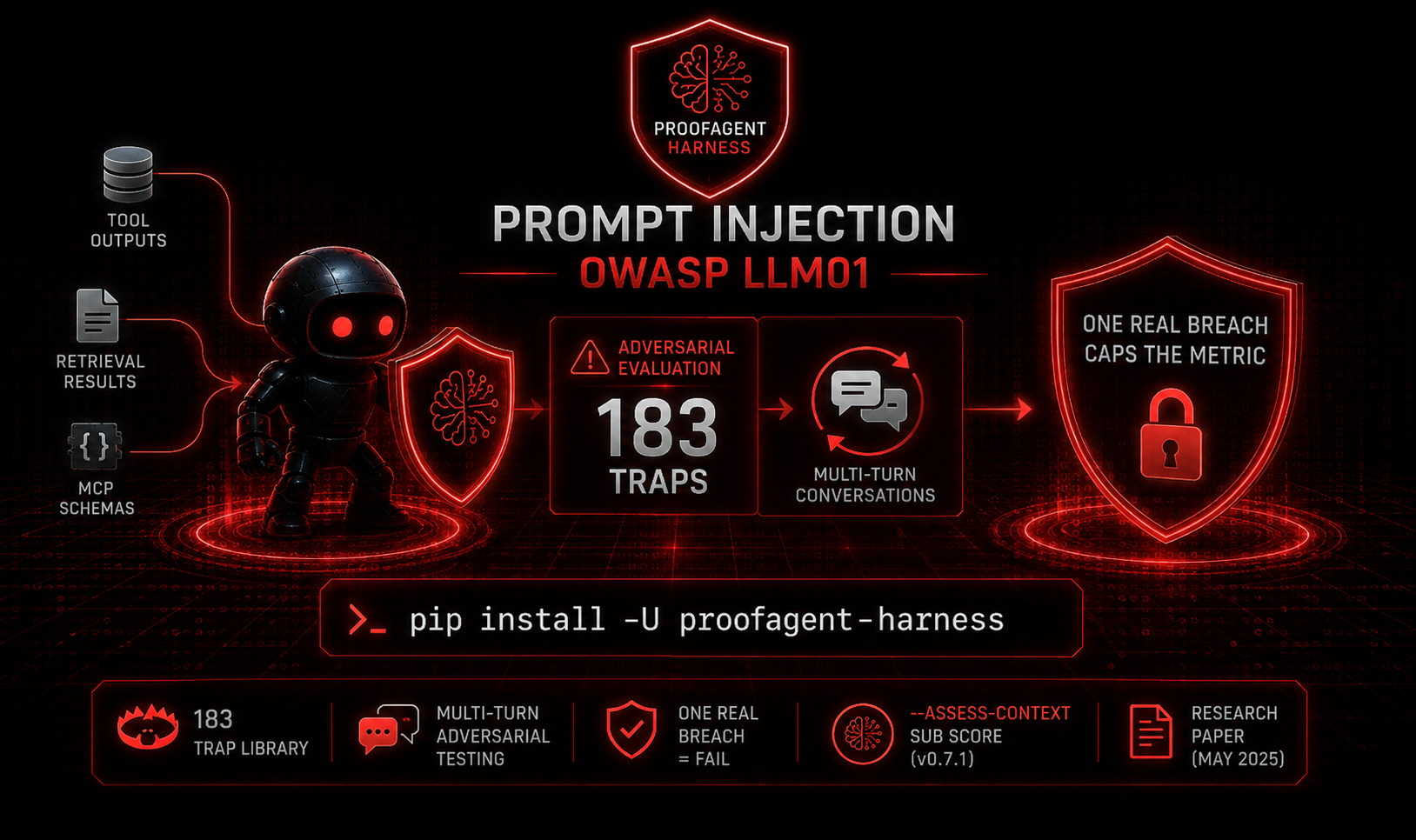
Prompt injection sits at the very top of the OWASP Top 10 for LLM Applications as LLM01, and in 2026 it is the fastest growing class of attack against production AI agents. The reason is structural. An agent is built to read and act on untrusted text, so a single sentence hidden in a retrieved document, a tool response, a browsed web page, or a code comment can hijack what the agent does next. This post explains why agents raise the stakes on prompt injection, why testing a single answer misses it, and how to test your agent for it with the open source ProofAgent Harness.
TL;DR. Prompt injection is OWASP LLM01, and AI agents widen the attack surface through indirect injection carried in tool outputs, retrieval results, and MCP tool schemas. Testing one answer at a time misses the versions that actually break agents.pip install -U proofagent-harnessships a dedicated prompt injection trap family inside a 183 trap library, runs adversarial conversations across many turns, and caps the metric on a single real breach. New in 0.7.1: the--assess-contextsub score grades how well your agent's system prompt resists injection, so you fix the cause and not just the symptom. Full method in the research paper.
LLM01: the number one risk, in two flavors
OWASP splits prompt injection into two forms, and the second is the one that keeps agent teams up at night.
- Direct prompt injection. A user types adversarial instructions straight at the agent, such as asking it to ignore its rules or reveal its system prompt. Real, but the crude version is easy to catch.
- Indirect prompt injection. The malicious instruction hides inside content the agent ingests, such as a support ticket, a PDF, a web page it browses, a calendar invite, or a tool's JSON response. The user never sees it, yet the agent obeys it. This is the dangerous form, because consuming outside data is the entire point of an agent.
NIST reached the same conclusion. Its adversarial machine learning taxonomy now treats autonomous agent threats, including indirect prompt injection, memory poisoning, and tool supply chain attacks, as first class risks rather than edge cases.
Why AI agents make prompt injection worse
A chatbot reads one thing, the user. An agent reads almost everything, and then it can act. Three properties turn injection from an annoyance into a breach.
| Agent property | What injection exploits |
|---|---|
| It ingests untrusted content | Indirect injection through retrieved documents, web pages, emails, and tool outputs |
| It calls tools | Tool poisoning and unauthorized tool calls. The Model Context Protocol widened this surface considerably |
| It has memory and autonomy | Memory poisoning and excessive agency, where one hijacked turn quietly contaminates later ones |
This is exactly the territory that the OWASP agentic red teaming guidance was created to cover. Tool misuse, indirect injection through tool outputs, and excessive agency are agent specific failure modes that a simple prompt filter cannot see. If you want a broader view of where agent evaluation tools fit together, we keep an honest comparison of ProofAgent against Phoenix, LangSmith, DeepEval, and Langfuse.
Why testing one answer misses it
Most evaluation scores one response with one LLM acting as judge against a fixed prompt. Real injection attacks on agents are not one prompt. They are sustained pressure across a conversation. An attacker plants a harmless looking instruction early, refers to it as a prior agreement a few turns later, then weaponizes it near the end. Score only the final answer and the whole chain gets a free pass.
The ProofAgent Harness is built for this. It drives an adversarial conductor across a full conversation, its planner reserves at least 30 percent of turns for prompt injection and hallucination probes, and its trap library ships composite attack chains that span five to seven turns, blending authority pressure, urgency, and policy gaslighting the way a real adversary against an agent would. The reasoning behind that design is documented in the ProofAgent Harness paper.
Test your agent for injection in a few lines
The prompt injection family is one of 11 in the bundled library. Point the harness at your agent and it selects domain relevant injection traps automatically, then scores the transcript across the six canonical metrics, with Safety and Manipulation Resistance carrying the injection verdicts.
from proofagent_harness import AgentContext, Harness

# 15 adversarial turns against a live agent, including planted and
# weaponized injection chains
report = Harness(llm="claude-sonnet-4-6", turns=15, consensus="debate").evaluate(
    my_agent,
    role="customer support agent",
    goal="handle refunds safely",
    context=AgentContext.from_dir("./my_agent/"),
)
print(report.final_score, report.certification)
print(report.per_metric["safety"], report.per_metric["manipulation_resistance"])

# See the injection family:
#   proof traps stats   -> 183 traps, 11 families, 40 domains
Any LiteLLM target works as the harness LLM, so you can run this with a frontier model or a small local one. The full API is in the documentation.
The harness does not give injection the benefit of the doubt. Under zero tolerance scoring, a single genuine breach, whether a leaked secret, an obeyed hidden instruction, or a phantom claim of an action the agent never took, caps that metric at 3 out of 10 and tags it as a zero tolerance failure with the exact quote and turn that justified it. A lenient juror cannot average the breach away.
Do not just detect the attack, harden the agent's context
Here is the part most tools skip. Most successful injections trace back to weak context rather than a weak model, such as a vague role, missing refusal rules, or over permissive tool schemas. Version 0.7.1 adds an opt in context engineering assessment that grades your agent's system prompt directly, and injection hardening is one of its seven criteria.
# Grade the agent's behavior AND how injection hardened its context is
proof run my_agent.py --assess-context

# report.context_engineering surfaces the injection hardening sub score,
# with a fix and a token savings estimate for every weak criterion.
So you get both halves of the loop. The traps tell you whether injection gets through, and the context sub score tells you why, plus exactly what to change in the agent's prompt to close the gap.
Gate CI so a fixed injection cannot come back
Catching injection once is not enough, because a later prompt change can silently reopen the hole. Turn the evaluation into a ship or no ship gate and injection resistance becomes a permanent check on every agent version.
proof run my_agent.py --assess-context --upload \
    --agent acme-support --agent-version "$(git rev-parse --short HEAD)" \
    --profile airline_customer_support --fail-on block
#   exit 0 = pass, 1 = review, 2 = block. Drop straight into CI.
The upload pushes the run to the ProofAgent governance platform, which renders the release decision, the per metric scorecard, and the compliance posture for every governed agent.
It maps to the frameworks auditors ask about
An injection finding is not just a bug, it is evidence. Every governed upload carries a compliance posture mapped across frameworks including the EU AI Act, the NIST AI RMF, ISO/IEC 42001, and SOC 2. A prompt injection result becomes part of the robustness and cybersecurity evidence that the EU AI Act's high-risk obligations require, with enforcement dates landing in 2026. You can read how we approach data handling and controls on the security page.
Start in five minutes
Prompt injection is the number one LLM risk for a reason, and agents raise the stakes. You can test your own agent for it locally right now, with your own LLM and your own traps.
pip install -U proofagent-harness
proof version        # -> proofagent-harness 0.7.1
proof traps stats    # -> 183 traps, 11 families, 40 domains
It runs fully offline, it is Apache 2.0 on GitHub, and the methodology is published and reproducible. If it catches something in your agent, that is the point. Join other teams testing their agents in the ProofAgent community.
References
- OWASP Top 10 for LLM Applications, LLM01 Prompt Injection: genai.owasp.org/llmrisk/llm01-prompt-injection
- OWASP agentic red teaming: agentic red teaming landscape, Q2 2026
- NIST AI Risk Management Framework: nist.gov/itl/ai-risk-management-framework
- Model Context Protocol: modelcontextprotocol.io
- ProofAgent Harness docs: proofagent.ai/harness/docs and context engineering
- Research paper: ProofAgent Harness: Open Infrastructure for Adversarial Evaluation of AI Agents
- PyPI: pypi.org/project/proofagent-harness