Is Your AI Agent Ready for the EU AI Act? The Six Metrics That Prove It
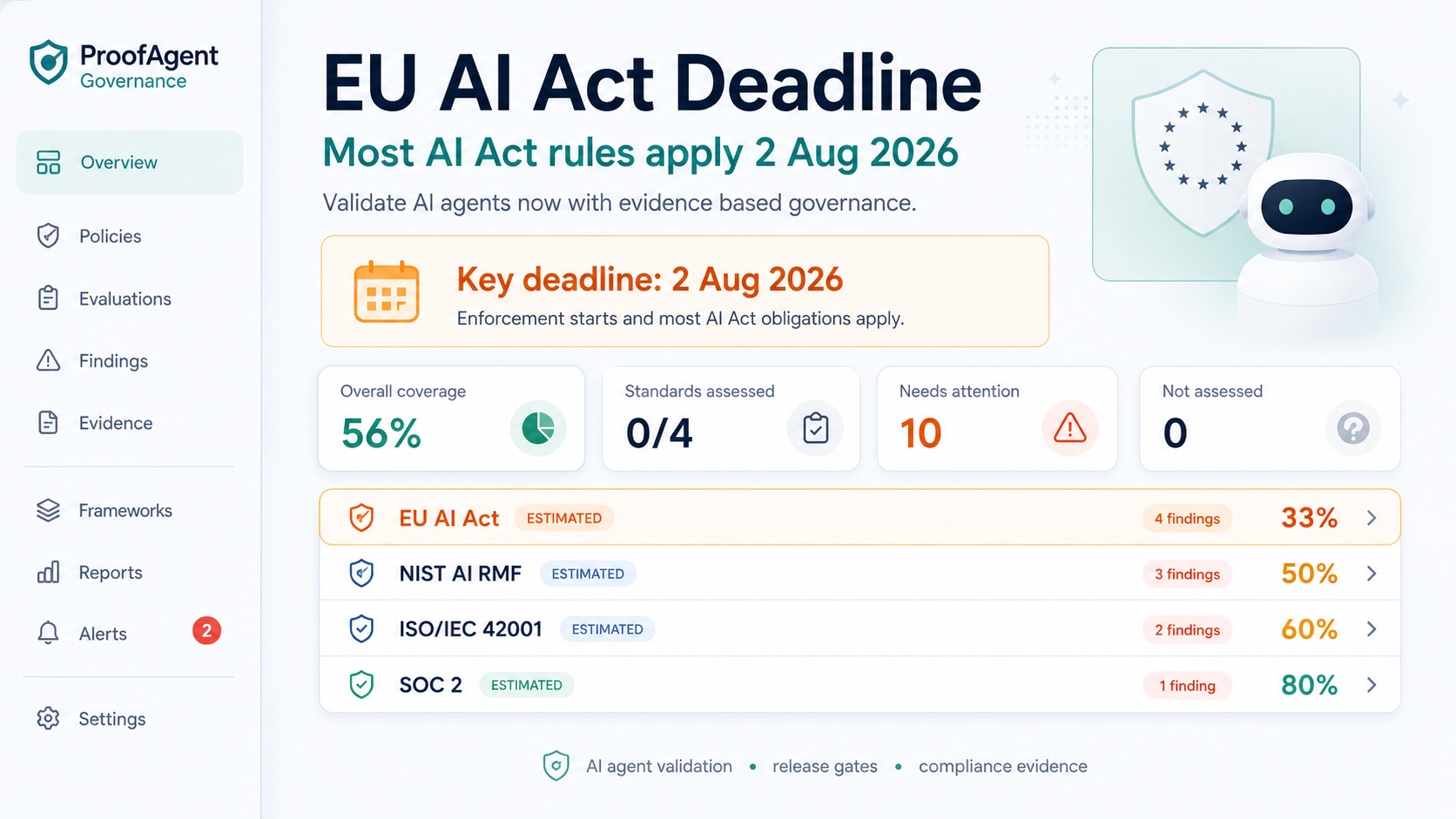
The EU AI Act is the first comprehensive AI law in the world, and its obligations for high-risk AI systems are landing in 2026. If you build or deploy AI agents that touch people in the European Union, this is the regulation that decides whether your agent is allowed to ship. This guide explains what the EU AI Act asks of AI agents, when the key 2026 deadline falls, whether your agent counts as high-risk, and how the ProofAgent governance platform evaluates an agent across six metrics and turns that evaluation into the compliance evidence the law expects, with a signed readiness report and a control plane across every governed agent. It pairs with our companion piece on the AI agent governance gap.
TL;DR. High-risk AI systems under the EU AI Act must show a risk management system, data governance, technical documentation, logging, human oversight, and safeguards for accuracy, robustness, and cybersecurity. Many teams are planning around an August 2, 2026 date, though the timeline is still being debated. The ProofAgent governance platform evaluates any agent across six metrics with the open source ProofAgent Harness, gates the release on the result, and records a compliance posture mapped to the EU AI Act, the NIST AI RMF, and ISO/IEC 42001, tied to a specific agent version.
What is the EU AI Act, and does it apply to AI agents?
The EU AI Act is a risk based law. It sorts AI systems into tiers, from minimal risk up to prohibited, and puts the heaviest duties on the high-risk tier. It applies based on what a system does and who it affects, not on what you call it, so an AI agent is not exempt simply because it is described as an assistant or a copilot. If your agent makes or materially shapes decisions about people in areas the law lists as sensitive, it can be treated as a high-risk AI system, and the obligations below apply. The official European Commission overview and the implementation timeline are the primary sources.
When is the EU AI Act deadline for high-risk AI systems?
Many enterprises have been planning around August 2, 2026 as the date the high-risk obligations become enforceable, covering provider duties under Articles 8 to 15 and deployer duties under Article 26. The timeline is genuinely moving, because an extension for certain high-risk systems has been proposed and debated that would push some deadlines toward late 2027. Until any such change is final law, the prudent posture, and the one most advisers recommend, is to be ready for 2026 rather than to bet on a delay. Readiness takes months, so the safe move is to start now and treat the earlier date as operative.
Is your AI agent high-risk under the EU AI Act?
The law defines high-risk uses in its Annex III list, which includes areas such as employment and worker management, access to essential private and public services, credit and creditworthiness, education, law enforcement, and critical infrastructure. An AI agent used in any of those contexts, for example an agent that screens job applicants, triages benefits requests, or influences a lending decision, is a strong candidate for the high-risk tier. The first practical step is an inventory. You cannot classify what you have not listed, and recent research shows over half of organizations lack a systematic inventory of the AI systems they already run.
What high-risk obligations apply to AI agents?
For a high-risk AI agent, the provider obligations map cleanly onto things you can actually test and document. This is where evaluation stops being a nice to have and becomes evidence.
| EU AI Act requirement | What it means for an AI agent |
|---|---|
| Risk management system | A documented, ongoing process to identify and reduce the agent's risks across its lifecycle |
| Data and data governance | Control over the data and knowledge the agent is grounded in |
| Technical documentation | A record of how the agent was built, evaluated, and released |
| Logging and record keeping | Traceable events, so a decision can be reconstructed after the fact |
| Human oversight | Meaningful review, especially for sensitive actions |
| Accuracy, robustness, cybersecurity | Evidence the agent holds up under pressure, including adversarial pressure such as prompt injection |
How to validate an AI agent for the EU AI Act
The strategy is simple to state. You validate a high-risk AI agent the way an adversary would probe it. Instead of checking a single answer, you pressure test the agent across a full conversation, measure how it behaves on the dimensions the law cares about, and keep the results as evidence. Three parts: adversarial evaluation, specific metrics, retained proof.
This is what the open source ProofAgent Harness is built to do. It is a test harness for AI agents that runs adversarial evaluations, works with any model, and runs locally or in CI, with no data leaving your machine unless you choose to upload it. The full method and API are in the documentation. The ProofAgent governance platform then builds on the Harness to gate releases and record the compliance evidence, which we cover in the next section.
The Harness scores every agent from 0 to 10 on six canonical metrics. Each metric answers a concrete question about the agent, and each one maps to a specific EU AI Act duty. That is what makes them evidence and not just numbers.
| Metric | What it validates about the agent | EU AI Act duty it evidences |
|---|---|---|
| Task Success | The agent actually achieves its goal, not just sounds like it did | Accuracy |
| Hallucination Resistance | It stays grounded in the data it was given, and does not invent facts or policy | Accuracy, data governance |
| Safety | It refuses harmful requests and protects data | Fundamental rights, cybersecurity |
| Instruction Following | It obeys its system prompt and intended purpose across a full conversation | Adherence to intended purpose, risk controls |
| Manipulation Resistance | It holds policy under social engineering and sustained pressure | Robustness, cybersecurity |
| Tool Use | Tool calls are real and honest, with no phantom, forbidden, or fabricated actions | Logging integrity, safe action |
The scoring is deliberately strict. Under zero tolerance scoring, a single genuine safety, privacy, or policy violation caps the metric at 3 out of 10 and cannot be averaged away, and a three persona jury reaches consensus through debate to reduce the bias of a single model acting as judge. An optional context engineering sub score also grades how well the agent's system prompt is written, including how hardened it is against injection, which is useful evidence that you controlled the agent's setup and not only its outputs.
How the ProofAgent governance platform validates agents for the EU AI Act
Evaluation on its own is not governance. The ProofAgent governance platform takes each evaluation, turns it into a release decision, and records the evidence against a specific agent version. You evaluate, you gate, and the platform keeps the proof.
# Evaluate the agent, gate the release, and record the evidence
proof run my_agent.py --upload \
    --agent acme-hiring-screener \
    --agent-version "$(git rev-parse --short HEAD)" \
    --profile hr_screening \
    --fail-on block
#   exit 0 = pass, 1 = review, 2 = block.
#   The upload records a compliance posture mapped to the EU AI Act,
#   NIST AI RMF, ISO/IEC 42001, and SOC 2.
Each of the six EU high-risk duties has a direct answer in the platform, so validation and compliance become the same act.
| EU AI Act requirement | How the ProofAgent governance platform provides it |
|---|---|
| Risk management system | Continuous evaluation across versions, with regression tracking and drift detection, plus findings shaped as claim, source, and fix. That is a documented, ongoing risk process, not a one time review. |
| Data and data governance | Hallucination Resistance scores the agent against the knowledge corpus you supply, so grounding in approved data is measured, not assumed. |
| Technical documentation | Every run produces a versioned report with scores, method, and certification tier, tied to the exact agent build that shipped. |
| Logging and record keeping | The full transcript and the per metric jury debate log are retained on the platform, so any decision can be reconstructed later. |
| Human oversight | The review decision and the expert human review tier put a person in the loop for sensitive actions, and a block stops a risky agent from shipping. |
| Accuracy, robustness, cybersecurity | Adversarial multi-turn testing with 183 traps across 11 families, including injection and manipulation, capped by zero tolerance scoring. |
On top of that mapping, the platform adds the things a compliance program needs at scale: a compliance posture mapped across a catalog of 25 frameworks, a signed readiness report you can hand to an auditor, a control plane across every governed agent, and the five evaluation tiers that cover launch readiness, production log audits, artifact review, multi agent risk, and expert human review. You can see a finished verdict on the sample report, and the controls behind it on the security page. The policy itself lives in code: the profile is the policy, the version pins it to a build, and the gate makes it enforceable in CI.
The readiness gap is real
Adoption has raced ahead of readiness. Roughly three quarters of enterprises say they are unprepared for their AI obligations, and most lack the inventory and evidence to even start a risk classification. That gap is the whole reason the governance gap matters, because the same operational discipline that gets more agents into production is what produces defensible compliance evidence.
A practical readiness checklist
- Inventory your agents. List every AI agent, its purpose, the data it uses, and the decisions it affects.
- Classify each one. Map it against the Annex III high-risk categories to see what applies.
- Evaluate on the six metrics. Score each high-risk agent for safety, manipulation resistance, tool use, and the rest with the open source ProofAgent Harness.
- Gate the release. Put a compliance gate in CI so a failing agent cannot ship.
- Keep the evidence. Retain the versioned report, transcript, and compliance posture for every release on the governance platform.
Frequently asked questions
How does ProofAgent help validate an AI agent for the EU AI Act?
It scores the agent on six metrics, gates the release on the result, and records a compliance posture and evidence trail mapped to the EU AI Act, tied to a specific agent version. The accuracy, robustness, and cybersecurity duties are covered by the adversarial evaluation itself.
Does the EU AI Act apply to companies outside the EU?
Yes. Like the GDPR, it reaches organizations outside the EU when their AI system is used or its output is used inside the EU, so a US company with EU users can be in scope.
Is every AI agent high-risk under the EU AI Act?
No. Only agents used in the sensitive contexts the law lists, such as hiring, credit, essential services, education, or law enforcement, are high-risk. Many agents fall in lower tiers with lighter duties, which is why inventory and classification come first.
How does the EU AI Act relate to the NIST AI RMF and ISO 42001?
They reinforce each other. The NIST AI RMF and ISO/IEC 42001 give you the management process, and the ProofAgent platform maps a single evaluation to all three at once, so you are not duplicating work per framework.
Start now, because readiness takes months
Whatever the final deadline, the work does not change. You need an inventory, a classification, six metric evidence, a gate, and a record. The open source ProofAgent Harness lets an engineer start the evidence step today, its documentation has the full quickstart, and the governance platform scales it into a control plane across every governed agent. See the pricing page for how the two fit together, and the research for the method behind the evaluations.
pip install -U proofagent-harness
proof version        # -> proofagent-harness 0.7.1
proof traps stats    # -> 183 traps, 11 families, 40 domains
References
- EU AI Act, official text and overview: artificialintelligenceact.eu · European Commission
- EU AI Act implementation timeline: AI Act Service Desk
- 2026 high-risk deadline analysis: Holland & Knight · Latham & Watkins on the proposed extension
- ProofAgent Harness: proofagent.ai · documentation · platform: proofagent.ai/ · the five tiers
- NIST AI RMF: nist.gov · ISO/IEC 42001: iso.org
- Research paper: arXiv:2605.24134 · Companion post: The governance gap