How an AI Agent Gets Work Done
Let us follow one request all the way through, from the moment it arrives to the moment something has actually happened. The agent is the travel assistant we have been building up since Chapter 1.
Let us follow one request all the way through, from the moment it arrives to the moment something has actually happened. The agent is the travel assistant we have been building up since Chapter 1. We will call it TravelBooker.
The request: “Book me a flight to New York on Monday morning, and set up a meeting with Sarah that day.”
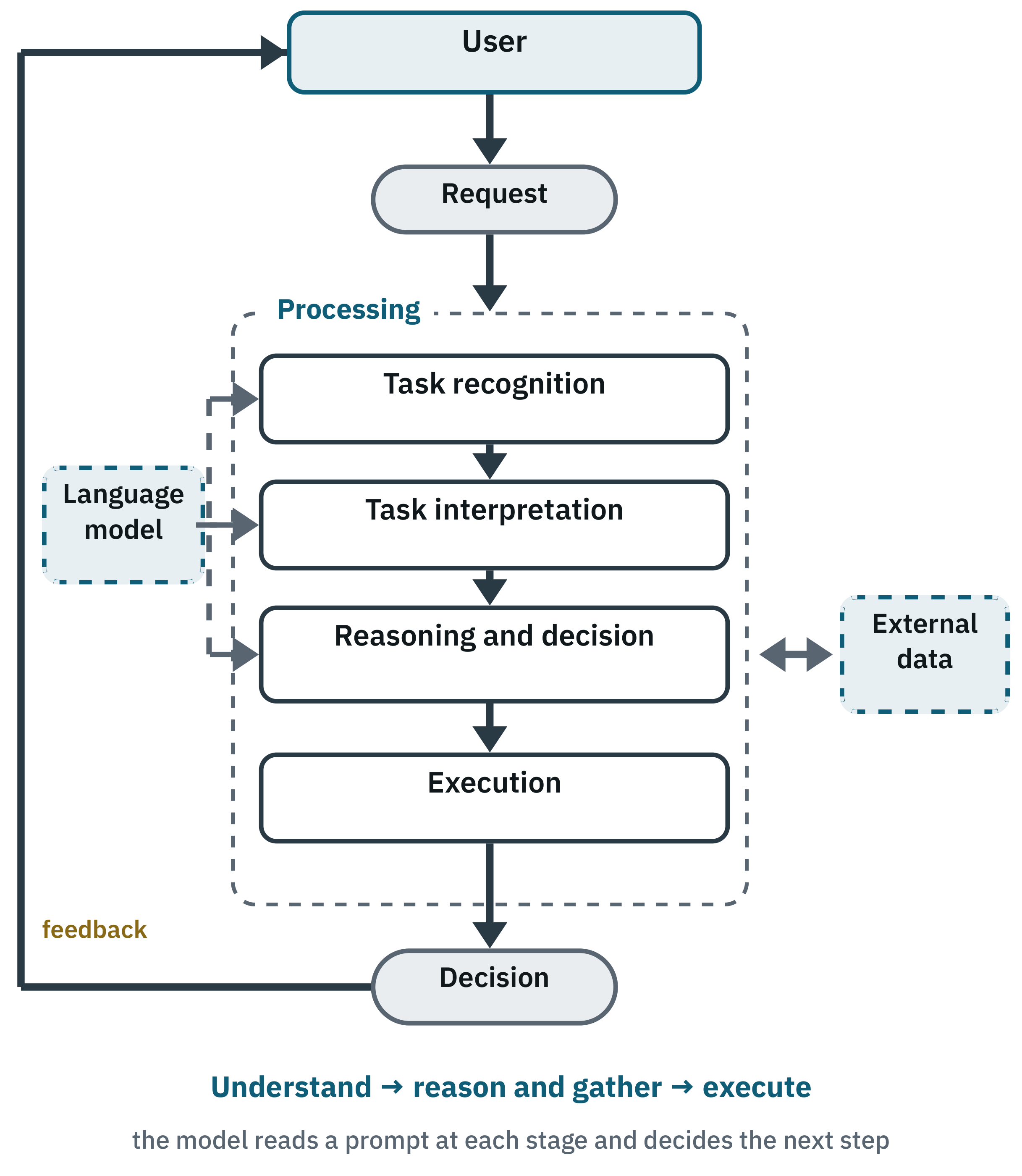
Three stages
Real agents run a more tangled sequence than any diagram admits, but it compresses usefully into three stages:
- Understand. Work out what the person actually wants.
- Reason and gather. Plan the work and collect what is needed.
- Act. Check with the person where it matters, then do it.
What is actually driving the loop
It is tempting to say that prompts drive an agent, because the model is the interesting part. That is not quite right, and the imprecision causes real confusion later.
An agent is a combination of things working together:
- Model reasoning, which interprets the request and decides what to do next. This is the part prompts shape.
- Ordinary software, written by a developer, which does everything that does not need judgement: parsing a date, validating a response, retrying a failed call, formatting a request.
- Tool calls, which reach outside systems and bring results back.
- Rules, which constrain what may happen regardless of what the model concludes.
- Memory, which supplies context the model would not otherwise have.
- Execution logic, which sequences all of it and handles what goes wrong.
So the model is consulted repeatedly, and its answers steer the loop. But a great deal of what makes an agent reliable is deterministic code that does the same thing every time. That is a feature, not a shortcoming: the parts you can make predictable, you should.
Stage one: understanding
Goal: identify the separate tasks inside the request.
You are TravelBooker, an assistant for travel booking and schedule management. Identify and classify the tasks in the following user request.
What comes back:
Table 6-1: Tasks identified in the request
| Task | Kind |
|---|---|
| Book a flight | Travel |
| Schedule a meeting | Calendar |
Two tasks, not one. Getting that separation right early prevents the agent from conflating them later — for instance, booking a flight that lands after the meeting it is supposed to enable.
Stage two: reasoning and gathering
Goal: turn each task into steps, then collect what those steps need.
For the following request, break each task into a step-by-step plan before retrieving anything or taking any action.
The instruction to plan before acting is deliberate, and it is one of the most useful habits in agent design. It is far easier to inspect a plan than to unpick a sequence of actions that has already run.
Table 6-2: The plan the agent produced
| Step | What it uses |
|---|---|
| Recall the traveller's preferences | Memory |
| Search Monday morning flights | Flight service |
| Compare on price, timing and seat | Its own logic |
| Check Sarah's availability | Calendar |
| Pick a slot that works after the flight lands | Its own logic |
| Prepare both for confirmation | — |
Only once the plan is clear does the agent retrieve anything. And notice the last line: the plan ends at prepare, not at book. That is on purpose.
Stage three: checking, then acting
Here is the step most walkthroughs get wrong, including a lot of real products.
Booking a flight spends money. It is hard to undo, it appears on somebody's card, and if the agent has misread “Monday” the cost of finding out afterwards is much higher than the cost of asking first. So the agent does all the work up to the irreversible action, and then stops.
1 The agent presents what it has chosen. “Airline A, Monday 7:00 am, window seat, £214. Meeting with Sarah at 2:00 pm, which leaves three hours after landing. Book both?”
2 You approve. Or you do not — you say the 7:00 am is too early, and the agent revises without having spent anything.
3 Now the agent acts. It books the flight, sends the calendar invitation, and confirms both.
You keep nearly all of the speed. The agent did the searching, the comparing, the availability check and the scheduling arithmetic — the parts that were tedious. You gave up almost none of the control, because the one moment that mattered came back to you.
Table 6-3: The three stages
| Stage | What happened |
|---|---|
| Understand | Two tasks identified: a flight and a meeting |
| Reason and gather | A plan built, then live data retrieved |
| Act | Options presented, approval given, both completed |
Keeping track
Memory divides usefully into two kinds. Think of a whiteboard and a filing cabinet.
Within the session
Short-term memory keeps the agent oriented inside the current task. It holds what has been said so the conversation does not restart at every turn.
For TravelBooker, that means holding: destination New York, Monday morning, plus any preference mentioned along the way. Without it you would be asked for the destination four times.
It lives in the model's context window, and often in a session store alongside it. It is cleared when the session ends, unless something deliberately keeps it.
Across sessions
Long-term memory is what lets an agent become genuinely useful over time. It holds what is worth keeping between conversations.
Over months, TravelBooker learns that you prefer morning meetings, always pick a window seat and mostly fly to New York or San Francisco. So “book my usual” becomes a complete instruction. Chapter 8 covers where that gets stored and what the choices cost.
How the parts fit together
From a design point of view, the important thing is that none of this is one large program. An agent is built as separate modules, each responsible for one function, and joined by a coordinating layer that decides how the agent reasons, remembers and acts.
Every piece is replaceable: swap the model, add a tool, change where memory lives, write new instructions. That modularity is what makes agents maintainable — and it is what makes the multi-agent designs in Part V possible at all.
Table 6-4: The modules of an agent
| Module | What it does |
|---|---|
| Language model | Interprets the situation and decides the next step |
| Instruction manager | Stores and assembles what the model is told |
| Tool interfaces | Connections to outside systems |
| Memory store | Short-term and long-term state |
| Coordinating layer | Sequences the work and handles failures |
These are usually wired together with a framework rather than written from scratch. Chapter 8 goes through the options.
Key takeaways
- Agents follow a loop: understand, reason and gather, act.
- Prompts shape the model's contribution. The agent as a whole also runs on ordinary software, tool calls, rules, memory and execution logic.
- Planning before acting is what makes an agent's behaviour inspectable.
- Put the human checkpoint before the irreversible action, not in a review afterwards.
- Short-term memory holds the task; long-term memory holds the person.
- Long-term memory is engineered, not emergent.
- Agents are modular, joined by a coordinating layer. That is what lets them grow.
TravelBooker works because somebody decided what it was for, what it could touch, and where it had to stop. Those decisions came before any code. So before building anything, there is a harder question to answer: does this problem want an agent at all?